What is a precast culvert?
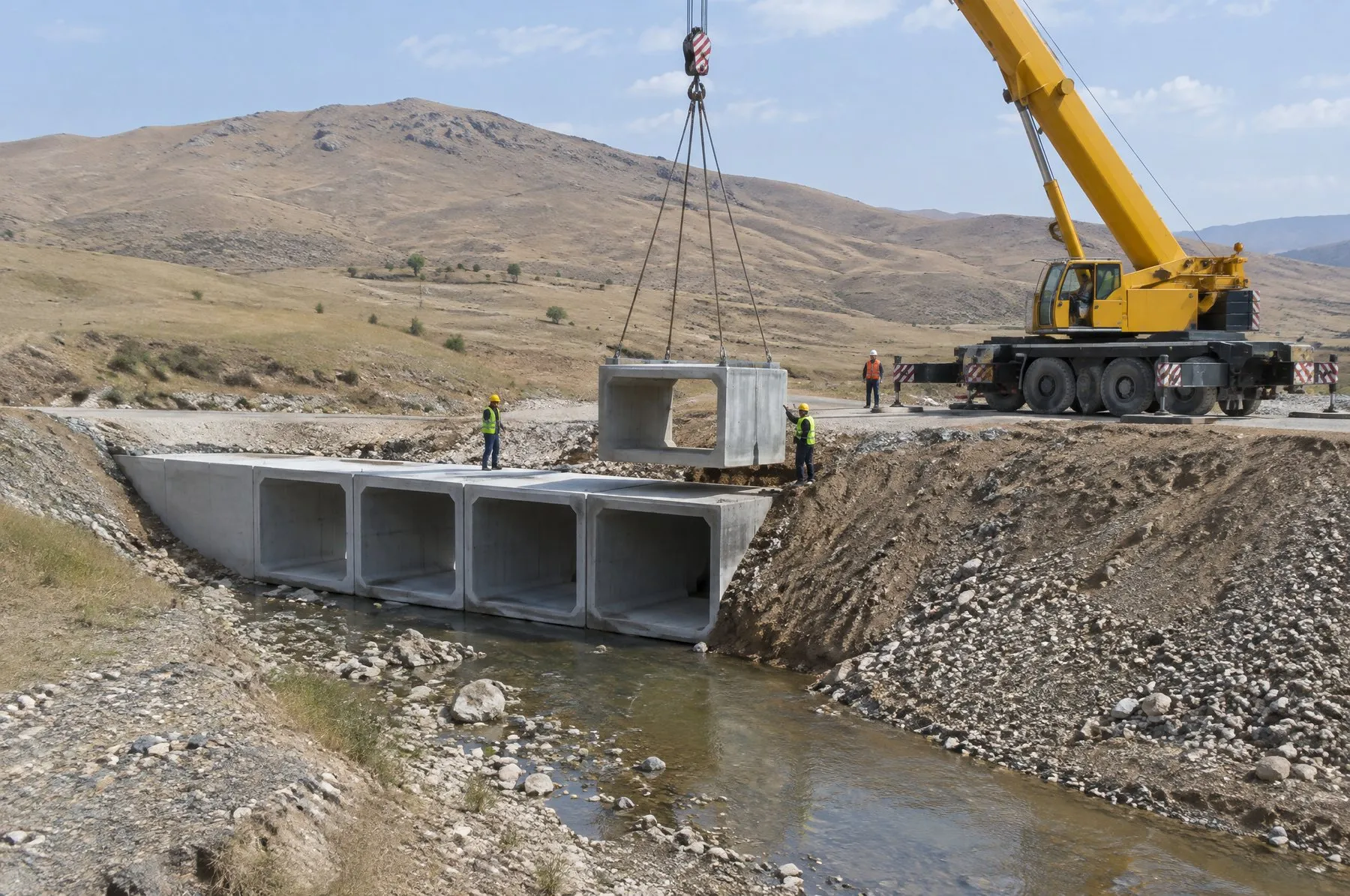
A precast culvert is a rectangular reinforced concrete structure that lets water pass through a road or railway embankment. It is made in the plant as segments of set length, which are placed end to end on site to form a crossing of the required length.
Its role
Where a road or railway crosses a stream, a dry valley or a surface water flow path, the culvert lets the water pass through without ponding against the embankment and protects the fill from water damage. The same structure can also serve as an underpass for farm tracks, pedestrians or livestock.
Types
Single-cell culverts consist of one closed box section. Where flows are high or the fill height above is limited, two cells are placed side by side to form a twin-cell culvert. U-section units are closed with a separate top slab, which makes larger sections easier to transport and lift. The opening size is set by hydraulic calculation, while wall and slab thicknesses and reinforcement follow from structural design for the fill height and traffic loading.
Production
Culvert segments are cast in steel moulds with a reinforcement cage. Segment ends are shaped with interlocking profiles that help line up neighbouring units, and lifting anchors are placed before casting. The concrete is compacted by vibration and cured under control. Each segment is checked for internal dimensions, wall thickness and the accuracy of its end faces.
Delivery and installation
The culvert bed is excavated and prepared to the required gradient with a compacted bedding layer or blinding concrete. Segments are placed in turn by crane and pushed together to line up. Joints are sealed with gaskets or a suitable sealant. Headwalls and wing walls are built at the inlet and outlet. The fill on both sides is placed and compacted evenly in layers. Because less time is spent working in the watercourse, risks linked to season and water level are reduced.
Hydraulic and environmental considerations
Culvert design accounts not only for everyday flow but also for flood flows. Rock armour or concrete aprons can be provided at the inlet and outlet to prevent scour. On watercourses where fish and wildlife passage matters, invert level and opening size can also be assessed with this in mind.