What is a concrete fence post?
A concrete fence post is a precast concrete post with steel reinforcement, to which fence wire or fence panels are fixed. Set into the ground at regular intervals, the posts form a continuous fence line together with the chain-link mesh, barbed wire or welded mesh panels strung between them.
Where it is used and what it does
The post is the structural framework of the fence: it transfers the forces from tensioned wire and wind to the ground. Concrete posts are used around industrial sites, warehouses, farmland and private property for security and to mark boundaries. In vineyards and orchards they also serve as the posts of the wire systems that support vines and fruit trees.
Post types
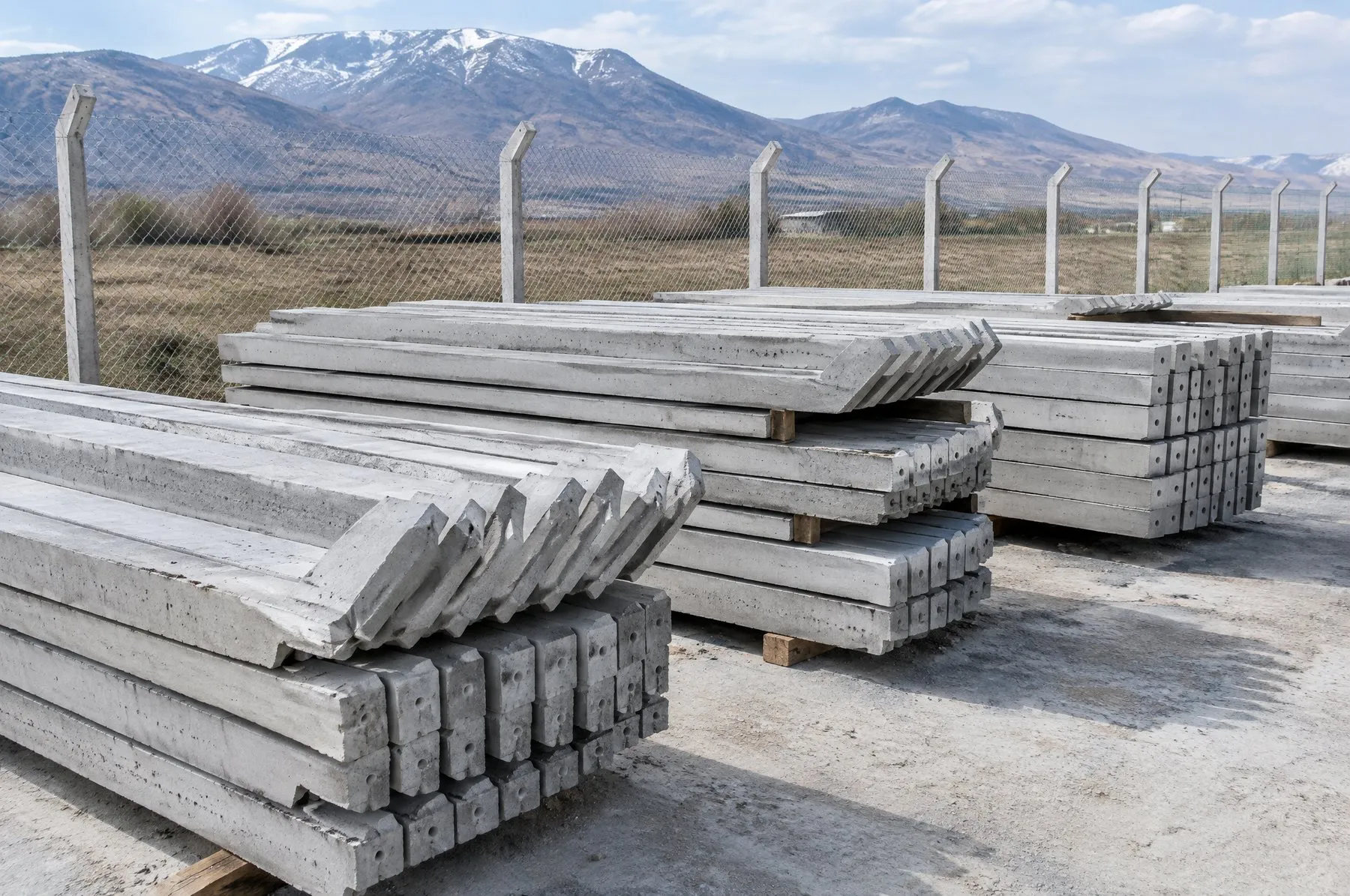
A fence line never uses a single post type. Intermediate posts simply carry the wire, while corner, end and straining posts take the pull of the tensioned wire, so they are made with a stronger section and are usually braced with angled struts. Posts with a cranked top, angled outwards or inwards, allow strands of barbed wire to be added above the fence. Holes or notches are formed along the post for fixing the wire. Post length, section and reinforcement are chosen to suit the fence height, the wire type and the ground.
Production
Fence posts are cast in steel moulds in the plant, with the concrete compacted by vibration. The reinforcement is placed in the mould before casting, and the posts are demoulded once they have cured and gained sufficient strength. Series production gives posts of the same size and appearance along the whole line. After dimensional and surface checks, the posts are stacked in the stock yard.
Delivery and installation
Posts are delivered to site on pallets or in stacks. Holes are dug, the posts are set to line and plumb, and they are fixed with concrete or well-compacted backfill. Corner and straining posts are given heavier footings than intermediate posts. Once the concrete has hardened sufficiently, the wire is tensioned and fixed to the posts. A concrete post will not rot like timber and needs no painting or rust treatment like steel, so it can stay in service for many years without maintenance.
Planning the fence line
A sound fence starts with setting out the route, the corners and the gate positions. Stronger posts are planned at gates and openings to carry the weight of the gate leaves. On sloping ground the posts are set vertically while the wire follows the slope of the land. If the fence height, wire type and any barbed wire topping are settled at the outset, post length, hole layout and section can be produced to suit, reducing add-on parts and changes on site.