What is a precast concrete ballast weight?
A precast concrete ballast weight is a precast block designed to hold the object it is attached to, or placed on, in position by its own weight. Its job is not to carry load but to restrain: its weight counteracts the forces trying to lift, float or drag the object away.
Where it is used
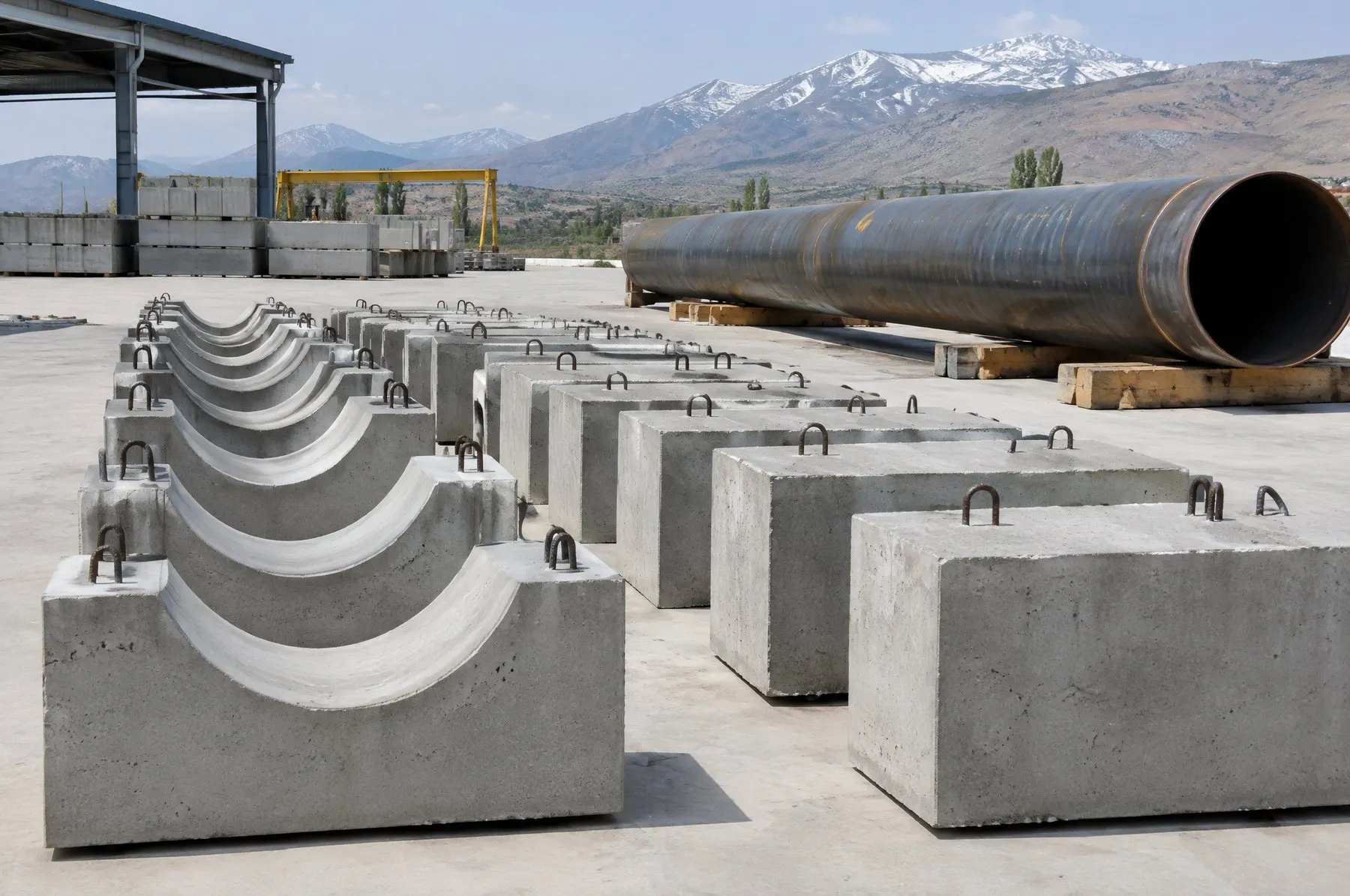
The most common use is on pipelines. A pipeline crossing water, a riverbed or ground with a high water table is pushed upwards by buoyancy, especially when empty; saddle weights or two-piece bolted weights placed on the pipe at intervals hold the line in place. Ballast blocks are also used as mooring anchors for buoys, floating jetties and fish farm cages, and to stop temporary fencing, signs and tents from blowing over.
Types and design
The shape of the weight follows the object it restrains: saddle and clamp types that wrap around the pipe for pipelines, and blocks fitted with a ring for mooring. Underwater, the effective weight of concrete drops by the weight of the water it displaces, so the required weight is calculated on its submerged weight. Weight spacing, block size and connection details are set by the design. Where needed, high-density aggregates can be used to achieve more weight in a smaller volume.
Production
Ballast weights are cast in steel moulds in the plant, with the reinforcement and lifting loops placed before the concrete is compacted by vibration. As they will face seawater, groundwater and freeze-thaw cycles, a concrete mix suited to the service environment is selected. On faces that bear on the pipe, a protective pad can be used to avoid damaging the pipe coating. Once cured, the weights are checked for dimensions and weight.
Delivery and placing
Weights are delivered by lorry and placed with a crane or plant machinery using the cast-in lifting loops. On pipelines, weights are set on the pipe at the intervals given in the design, either as the pipe is lowered into the trench or riverbed or once it is in place. For underwater mooring blocks, the chain or rope connection is made on shore before the block is lowered into position. The layout is designed with buoyancy and current effects in mind.
Why precast weights?
Casting weights in place on site is difficult and slow, especially at the water's edge and in narrow trenches. Plant-made weights can be produced and stocked in advance, brought to site at the pace of pipe laying and placed straight away. Because the weight of each unit is checked in production, it is also easy to confirm that the line has reached the required total weight.