What is a concrete boundary marker?
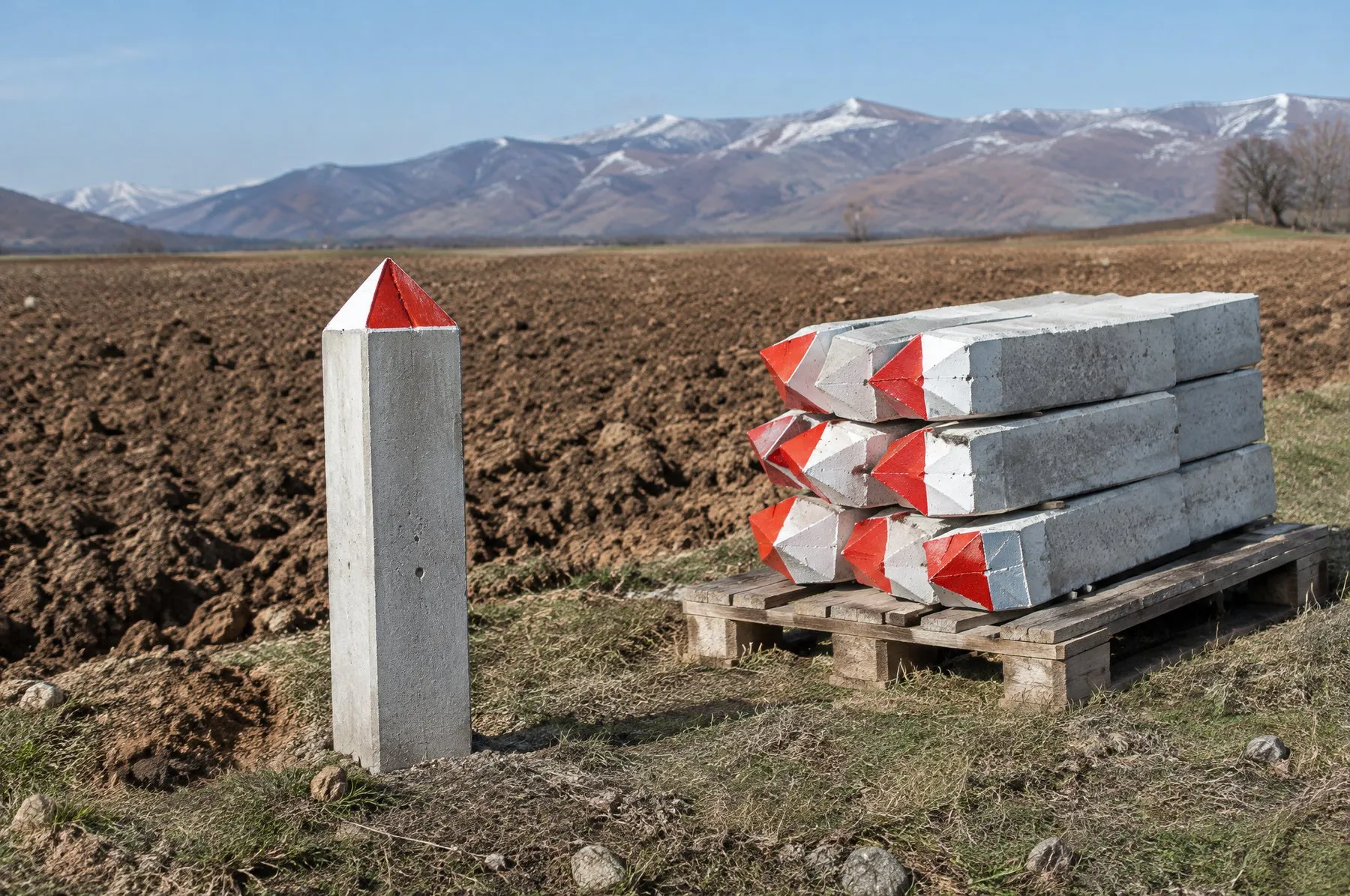
A concrete boundary marker is a precast concrete marker set at boundary points or at intervals along a boundary line, with part of its shaft buried in the ground. The head left above ground is designed to be seen from a distance and can carry letters, numbers or symbols.
Where it is used and what it does
Boundary markers show the edges of fields and plots on farmland, land-take and maintenance boundaries along roads and railways, and the limits of forest, pasture and protected areas. They are also used as route markers showing the line of buried pipelines and cables. A permanent, visible marker helps prevent a boundary from being lost over the years and avoids disputes with neighbouring landowners.
Types and marking
Boundary markers are usually produced with a square or rectangular section and a chamfered or pyramid-shaped top. Letters, numbers or symbols required by the owner or authority can be cast into the face, raised or recessed, using an insert placed in the mould. The head can be painted for better visibility. Marker length, section and marking layout are set to suit the need and the specification of the authority using them.
Production
Boundary markers are made in steel moulds in the plant, with reinforcement where required and concrete compacted by vibration. Because lettering and symbol inserts are placed in the mould before casting, the markings become part of the concrete and do not wear off over time. Once cured, the markers are checked for dimensions and for the legibility of the markings.
Delivery and setting
Markers are delivered to site on pallets. Once the boundary point has been set out by a survey team, the marker is set with a substantial part of its shaft below ground and fixed with compacted backfill or concrete. The buried section makes the marker hard to pull out or shift. A concrete marker stays in place far longer than a timber peg or a painted mark.
Why a concrete boundary marker?
Timber pegs rot over time, painted marks fade and farm machinery can easily knock markers out of place. A concrete boundary marker, with its weight, buried shaft and resistance to the weather, stays at the same point for many years. Because series-produced markers share the same shape and colour, the boundary line is easy to follow on the ground. For authorities and large landowners, numbered markers also make it easier to match boundary points with survey records.