What are precast drainage channels?
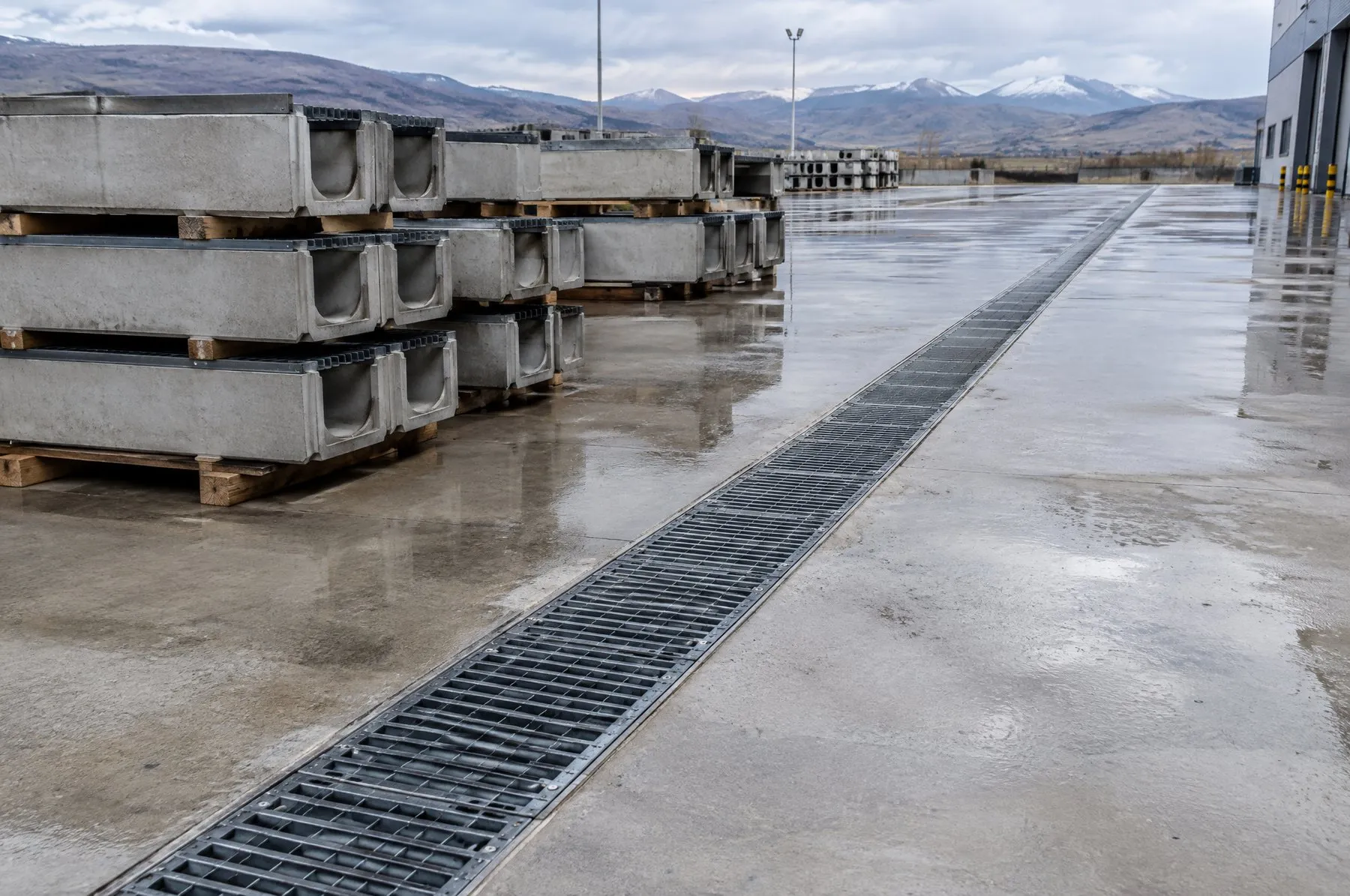
Precast drainage channels are concrete gutters and channels made at the plant to collect rainwater falling on a surface, carry it along a set line and discharge it into the surface water network. Laid end to end, the units form a continuous collection line on site.
Their role
Water left standing on impermeable surfaces seeps under the paving and weakens the sub-base, freezes in winter and damages the surface, and makes conditions less safe for pedestrians and vehicles. Drainage channels take water off the surface quickly. Placed at the low point of sloping pavements, in front of buildings or along site boundaries, they keep water away from buildings and pedestrian areas.
Types
Open concrete gutters carry water along road and kerb edges. In grated channels, water passes through the grating into the channel while the surface stays walkable and suitable for vehicles. Gratings can be made of concrete, cast iron or galvanised steel. The channel section is chosen for the volume of water to be collected, and the load class of grating and channel for the traffic that will cross it, from pedestrian areas to heavy goods vehicles. TS EN 1433 is the reference standard for this product group and also defines the load classes.
Production
Drainage channels are cast in steel moulds that give a smooth inner surface and accurate dimensions. Joint faces and grating seats are carefully formed so that end-to-end joints do not leak and the grating sits evenly on the channel. After curing, the units are checked for dimensions, surface finish and straightness of edges.
Delivery and installation
The units are delivered on pallets. The channel line is laid on a concrete bed in a prepared trench, to the falls and levels in the design, and haunched with concrete at the sides so that it does not move under load. At set points the line is connected to catch pits and surface water pipes. Setting the top of the channel slightly below the finished paving lets water run into it freely.
Drainage on industrial sites
The open yards, loading ramps and warehouse aprons of industrial sites are large impermeable surfaces that must handle a great deal of water even during short, heavy downpours. Here, channels are specified in a load class suited to forklift and lorry traffic, and the line is positioned in front of loading doors to keep water out of the building. Designing the drainage line together with the yard paving and kerbs makes it easier to set the falls correctly.